Just last week the Games of Consequence Lab were thrilled to present at Replaying Japan 2025! The 13th International Japan Game Studies Conference. The event took place on our own home soil, RMIT University City campus, and brought together some amazing game makers and scholars to reflect on the theme of Homebrew: hobbyist games, hacks and (other) homegrown activities.
 Charlotte Galvin giving her talk at Replaying Japan
Our game My Dream PC was very much at home as one inspired by both professional and hobbyist PC builders and engages with feminine cosiness. It’s a soft-simulation game where players decorate an empty PC with functional items, like fans and CPU coolers, as well as adorable ornamental figurines of animal characters and household objects.
MDPC has (rightly!) been welcomed and embraced in both academic and creative spaces:
- First showcasing at Feminine Play, an exhibition in Melbourne International Games Week (MIGW) 2024
- Currently installed and playable at the Australian Centre of the Moving Image (ACMI) Games Lab until mid-2026
- Subject of a development talk at Freeplay: Angles festival
In addition to the conference proceedings the game was installed in the demo showcase, where attendees built variations of their very own virtual PCs from tropical jungle paradises full of palm trees and green colour palettes, to tastier displays of sushi and ramen bowls as a celebration of Japanese cuisine.
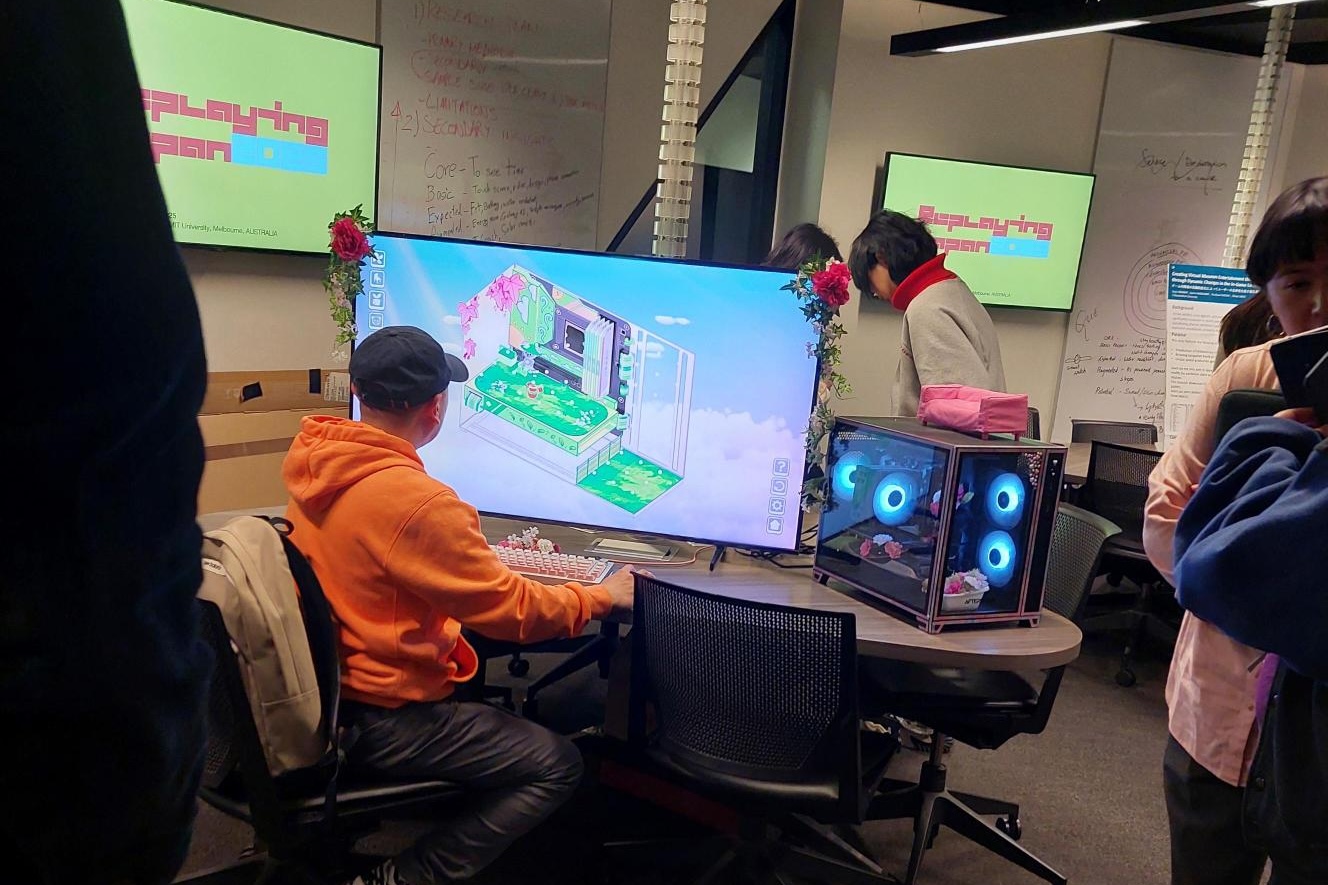 Conference attendees making their own virtual PCs
⊹♡ Talking Cosiness + Femininity ♡⊹
Lead designer Charlotte Galvin reflected on her development process, guided initially by the theme of femininity and Pink PCs before centring more closely on the three key tenets of cosy gameplay; safety, abundance, and softness. Charlotte also complicated cosiness, detailing the limitations of these themes within the design process and game mechanics.
MDPC was astonishingly made in just two months! This lead to a tight scope for the overall project so that proposals for mini-games, larger item sets, and a physical take-home for players were scrapped to dedicate time and energy to the main focus: mood and aesthetic pleasure. Working within femininity and cosiness guided not only the game outcomes but arguably the design process itself.
In contrast to popular PC building games such as PC Building Simulator which centres gameplay on typically masculine themes such as technical knowledge, power, and utilitarianism (all the while creating closed communities steeped in toxic geek masculinities) My Dream PC’s design is guided by cosiness and inspired by popular feminine PC building influencers and communities.
Safety is created through the game’s low difficulty, simple controls, straightforward object customisation and placement mechanics, and no prerequisites for technical knowledge.
Abundance is realised through diverse customisable assets and the absence of currency systems or monetary values for computer parts—distinguishing it from mainstream cosy games that often reproduce capitalist ideologies.
Softness permeates every aspect of the game design as players are accompanied by lo-fi beats as they browse soft-coloured, kawaii-inspired assets. Physical peripherals, such as a PC tower adorned with flowers, stickers, and figurines, plus a mechanical keyboard with a distinctive soft switch style, mirror the digital customisation options available in-game.
~ HOWEVER ~ Charlotte also made sure to include critique in her talk by explicitly outlining current trends in cosiness discourse, such as the shallowness of cosy games in genuinely contending with capitalist systems and attitudes ranging from sociopolitical complacency, over-consumption, plastic waste, and unsustainable growth.
As her first foray into conference presenting early-career academic Charlotte definitely killed it! The audience was left with plenty to think on and even more follow-up questions.
The conference itself was cosy and full of playful feelings of safety, abundance, and softness; from panels reflecting on the Japanese-ness and nostalgia of summers in Boku no Natsuyasumi 2, devs exploring memory through Zelda ROM hacks, and live demonstrations of more inclusive versions of the card game Kyogi Karuta.
Replaying Japan 2025 was a collaboration across many universities in Japan, Australia, Canada, United States, and Belgium, and organised wonderfully by James Manning, Lecturer of Digital Design at RMIT University.
𐙚₊˚Further Reading
Andiloro - Comfortably Numb: An Ideological Analysis of Coziness in Videogames
celestefleurs - Build your own pink/aesthetic gaming pc tutorial!
Harkin - Tech Competency and the Pink pc: Illuminating the iMac G3 and pc Builds