It’s been a month since Melbourne International Games Week (MIGW) wrapped up and the team at GOC are still recuperating after what was a busy and energising experience! This year’s programme was packed with more events than ever taking place all across Melbourne; from the big ticket events like PAX Aus and Freeplay: Parallels to the more industry-focused conferences like Games Connect Asia Pacific (GCAP).
Members from GOC spent their games week galavanting around town, catching up with peers, making new friends, all while taking part in their own talks, presentations, and demo installations.
ঌ Fireside with Lis Moberly ঌ
Our director Deb Polson was invited to moderate a fireside chat with games writer and narrative designer Lis Moberly as part of the Careers + Frontiers: Games Education Symposium. The event brought together educators and industry veterans to talk shop about the game development industry; how to break into it, stick around, and make the most of your creative potential.
Lis has worked in both academic and industry game roles, contributing to giant projects like Avowed and Hogwarts Legacy, as well as smaller indie titles like Cursed to Golf. She is currently a creative lead at 20th Century Games with the Disney Company, but while the two could have talked at length about her time there, they focused on more pressing topics including the importance of supportive teams, mitigating against burnout, and juggling work and creative life.
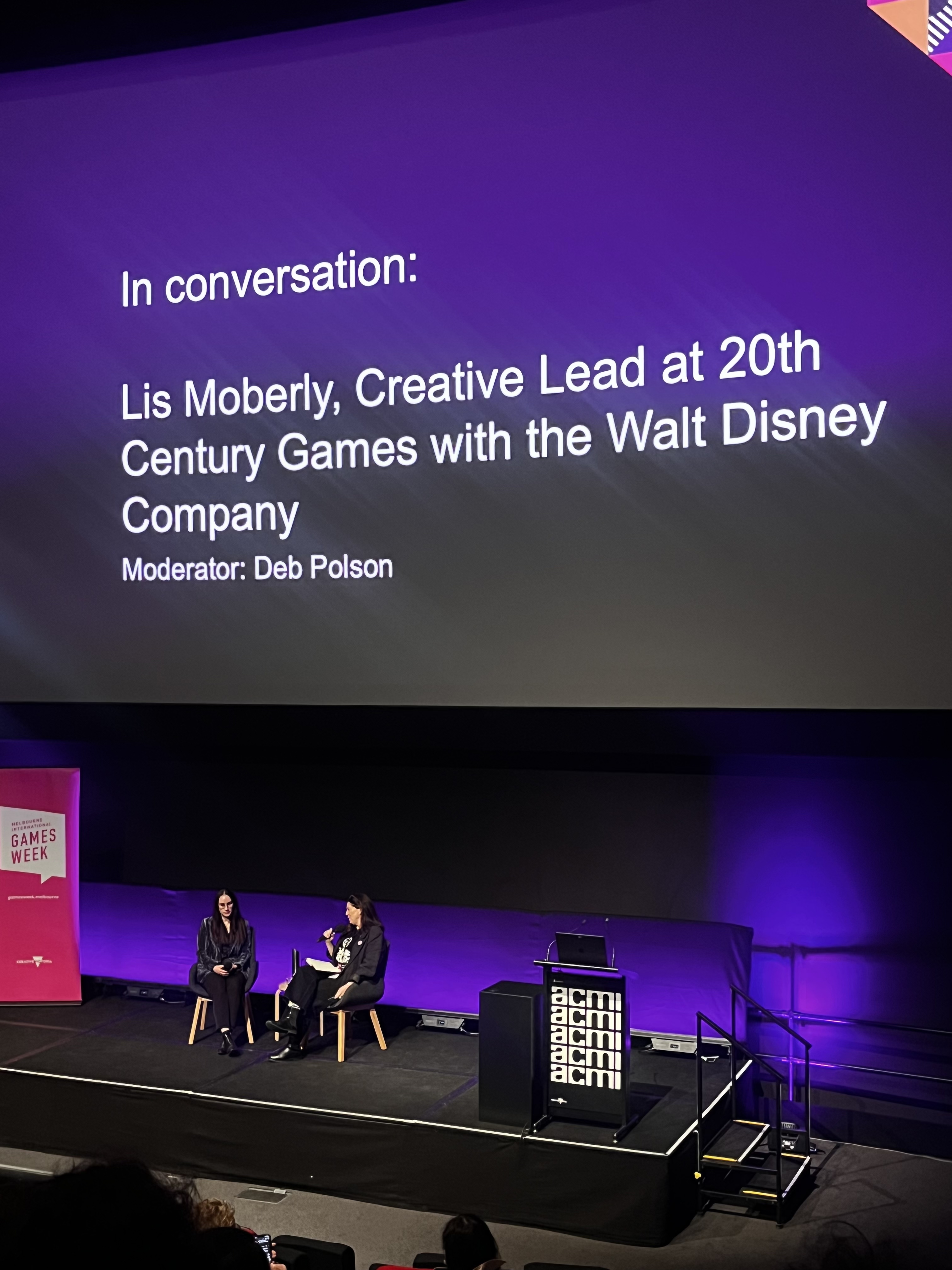 Deb and Lis having a chat on-stage
While it was absolutely a you-had-to-be-there experience, there were some vital lessons that we continue to reflect on. Lis went into detail about how she got into games and the need to find great communities and people to work with, rather than focusing on companies themselves. She outlined how companies can create practices which lead to burnout, but surprisingly admitted that she had suffered from burnout a second time without the same stresses. Lis said burnout doesn’t necessarily stem from crunch and overtime, but from losing a sense of belonging and agency within your work. This is why keeping your creative energies sustainable both in and outside of work is crucial.
A combination of Deb’s thoughtful questions and Lis’s generosity with her responses made for useful and compelling discourse—clearly reflected in how audience members had their eyes glued to the stage.
༄ In Deep Water at Games for Change ༄
Deb and our lead technical artist Iris Anstey also presented a talk and live demo of the game In Deep Water (IDW) at the Games for Change: Asia Pacific Summit (G4CAPAC)!
In their talk they mapped the evolution of the game from inception to its currently beautifully polished iteration. This was made possible through many design reflections, collaboration within the team, and play-testing at the CODE office and at events such as the ACMI + RMIT Audience Lab.
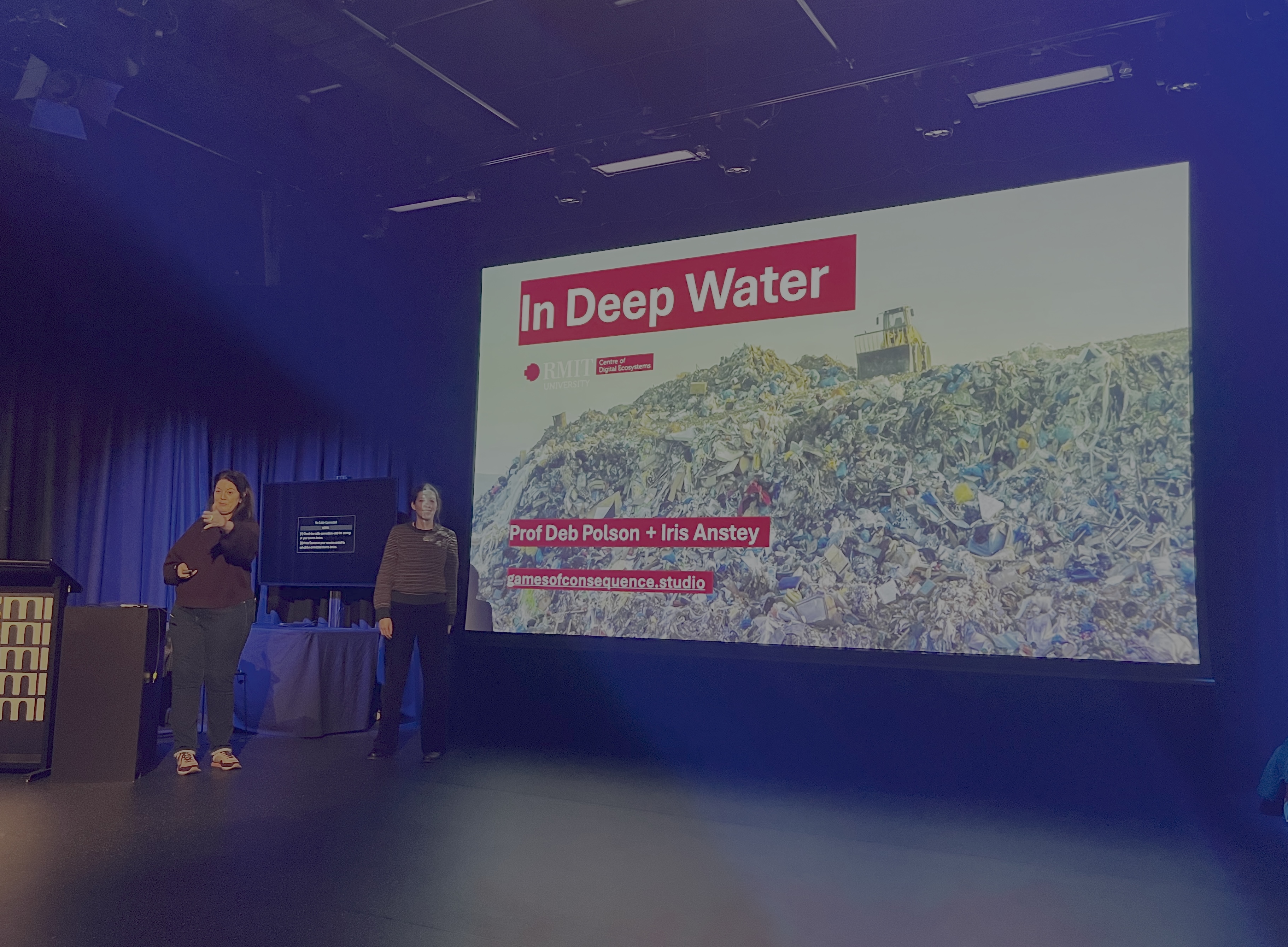 Deb and Iris presenting on In Deep Water
In Deep Water is inspired and created based on the scientific research efforts of marine biologists and plastics engineers in Asia Pacific, with collaborations between experts across Eastern Australia and New Zealand. The game doesn’t simply aim to inform and raise awareness about the effects of plastic on waterways but seeks to highlight what is truly at stake.
Iris and Deb said that many interventions would have to be made by large companies and stakeholders to make sure that plastic waste (and their leaching microplastics) can stop decimating the beautiful coastal scenes depicted in the game. Yet in order to achieve this the vital work that researchers are doing should be translated for the public, not simply stored away in research depositories. This is also where the element of play comes in!
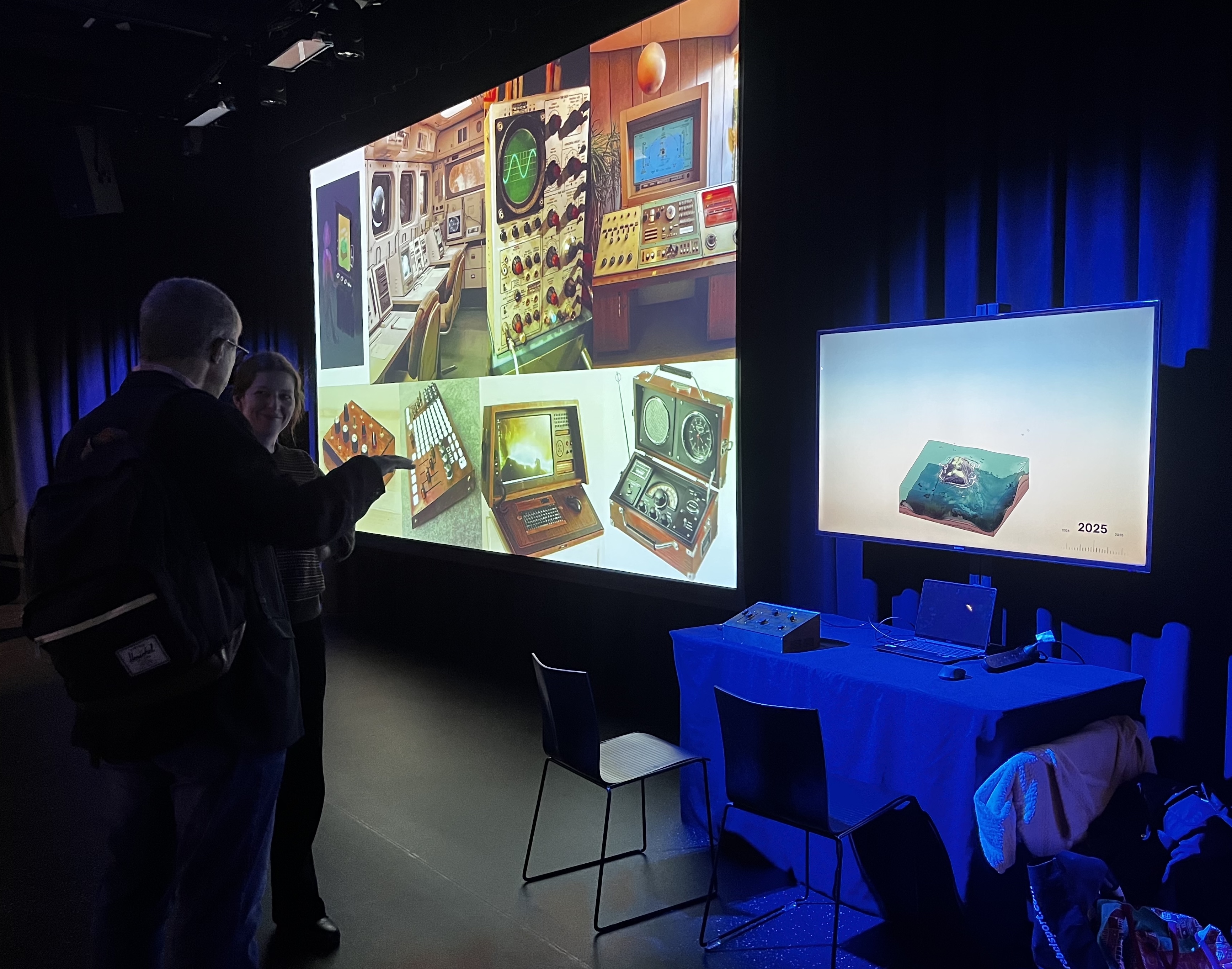 A fellow games peer about to playtest the IDW box!
The custom-created control panel “box” for IDW is a huge part of this translation work. Made from organic materials, the box is an invitation to discover ways of surveying the coast as a rogue scientist. Through zooming, sliding, rotating, and scanning, players are able to track beacons of scientific information and descramble them to build a larger picture of what’s really going on between plastics, environments, and wildlif—and what will continue to happen well into the future.
Many participants, including peers in game development and those from education backgrounds, were incredibly curious in their playtesting and often returned to play multiple times in order to retrieve as much information as possible.
While that’s Games Week done-and-dusted, the team continue working away at IDW and their larger NZ Plastic Ecosystems project to prepare for an upcoming trip to Aotearoa. They’re looking forward to a week of collaboration, workshops, and of course, lots of play!